SoftWave vs. Traditional Shockwave Therapy: The Differences, Explained Without the Hype
October 19, 2026
The short version: "Shockwave therapy" is a family of devices, not one thing, and SoftWave is a member of that family with a particular design: a broad, unfocused, low-intensity acoustic wave. Other devices use a focused wave that converges at a point, or a radial wave that spreads from the skin surface. They also sit on different regulatory footings — some focused devices hold FDA approval for a specific condition, while SoftWave's device holds FDA clearance for general indications. Neither of those facts tells you which device will work better for your shoulder. This post lays out the actual differences so you can ask better questions wherever you go.
Three kinds of wave
All extracorporeal shockwave devices do the same basic thing: generate an acoustic pressure wave outside the body and send it into tissue through a coupling gel. How they generate it, and what shape the wave has when it arrives, is where they differ.
Focused shockwave. The wave is generated (electrohydraulically, electromagnetically or piezoelectrically) and shaped so it converges at a focal point some distance below the skin. Energy is concentrated where the waves meet. These are the devices with the longest history in orthopedics, and higher-energy focused treatments are sometimes uncomfortable enough that local anesthesia is used.
Radial pressure wave. A projectile inside the handpiece strikes an applicator, and the pressure wave spreads outward from the skin surface, strongest at the surface and weaker with depth. These are common in physical therapy and sports medicine clinics and are often called "shockwave" even though the physics is somewhat different.
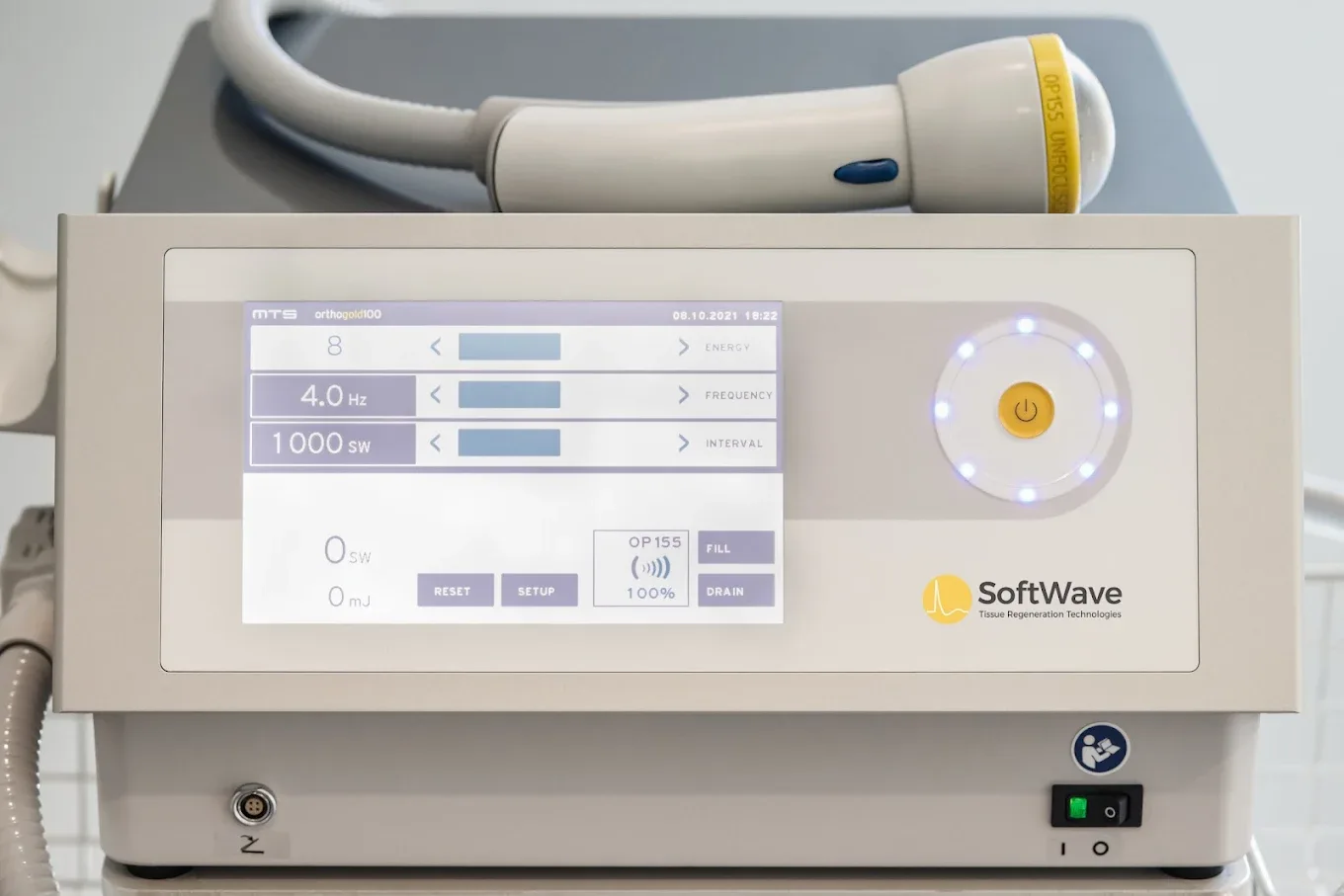
Unfocused (parallel) wave — SoftWave. The OrthoGold 100 generates its wave electrohydraulically — a spark discharge in a water-filled applicator head — and, rather than converging it, lets it travel outward as a broad front through a soft membrane into the tissue. The manufacturer's specifications list a maximum penetration depth of 25.4 mm at the top energy setting, sixteen intensity levels, and a pulse rate of 1 to 8 Hz.
The practical upshot: a focused device concentrates energy at a point you aim at; SoftWave spreads a lower intensity across a larger area. That is a design difference. It is not, by itself, an effectiveness claim in either direction, and anyone who tells you one design "works better" across the board is skipping the part where the evidence depends on the condition, the device and the protocol.
"FDA approved" vs. "FDA cleared" — and why it matters here
This is where the marketing on both sides tends to get sloppy, so here is the record.
Approval (a PMA) means the FDA reviewed clinical data for a specific device treating a specific condition. For example, the HealthTronics OssaTron, a focused device, received FDA approval in October 2000 for "chronic proximal plantar fasciitis that has failed to respond to conservative treatment." That's an approval, and it's condition-specific.
Clearance (a 510(k)) means the FDA found the device substantially equivalent to one already on the market. The OrthoGold 100 we use holds 510(k) clearance K210451 under the therapeutic-massager regulation, with indications for relief of minor muscle aches and pains, temporary increase in local blood circulation, and activation of connective tissue. Those are general indications, not a condition list. (SoftWave's manufacturer holds separate clearances for a related device in wound and burn care, which is not what we do here.)
So: if a clinic says its shockwave device is "FDA approved for plantar fasciitis," ask which device and for what — for some focused devices that's a true statement. If a clinic says SoftWave is "FDA approved," that's wrong; it's cleared, for the three indications above. We'd rather you hear the accurate version from us.
What the differences mean in the treatment room
Coverage. Because the wave is unfocused, a SoftWave session can cover a whole region — the entire rotator cuff, or a knee front to back — rather than a series of aimed points. For problems that involve a broad area of tissue, that's convenient.
Tolerability. SoftWave runs at comparatively low intensity and is done without anesthesia. You feel each pulse as a firm tapping; the intensity is adjustable and set to what you can tolerate. Higher-energy focused treatments may be a different experience, which is one reason to ask a clinic what device it uses before you book.
Locating the problem. With SoftWave, the sensation is noticeably stronger over irritated tissue, which helps Dr. Raby confirm the source of pain during the session. Practitioners of focused devices often use imaging or palpation to aim instead.
Downtime. None with SoftWave; you leave and use the limb normally.
Why Dynamic Chiropractic uses SoftWave
Dr. Raby uses the OrthoGold 100 for the reasons above: whole-region coverage in one session, tolerability without numbing, and a device that fits the conservative, exam-first way she practices. It is one tool. If the exam points to a problem that's better served by another treatment — or by an orthopedic referral — that's what you'll be told. Read more on our SoftWave therapy page, or start with our plain-English explainer on what SoftWave is.
How to choose
Whichever clinic you're considering, ask four questions: Which device, exactly? What is it cleared or approved for? What does a session involve, and is anesthesia used? How will we know whether it's working, and by when? A clinic that answers those without flinching is a clinic you can work with. Ours will. Book a $49 first visit — consultation, exam, any diagnostics, and your first SoftWave treatment — and bring your questions.
Frequently Asked Questions
Is SoftWave better than focused shockwave?
Neither is "better" across the board. They are different designs — unfocused, low-intensity and broad versus focused, higher-energy and aimed — with different regulatory histories, and the evidence for shockwave therapy varies by condition and protocol. What we can tell you is what our device is cleared for, how a session works, and whether the exam suggests it's a reasonable fit for your problem.
Why does Dynamic Chiropractic use SoftWave instead of another device?
Whole-region coverage in a single session, a treatment that's done without anesthesia or downtime, and a sensation that helps locate the irritated tissue during the session. Dr. Raby practices exam-first and conservatively, and SoftWave fits that approach. It is one tool, not the only one, and she'll refer you elsewhere if the exam calls for it.
Is it the same machine as the shockwave at my physical therapist's office?
Probably not. Many PT and sports clinics use radial pressure-wave devices, which generate the wave at the skin surface with a pneumatic projectile; some use focused devices. SoftWave's OrthoGold 100 is an electrohydraulic, unfocused device. Ask your PT which device they use — it's a fair question, and the answer tells you how comparable the two treatments are.