
Knee Pain Without Surgery: What "Bone-on-Bone" Really Means and Where SoftWave Fits
October 5, 2026
The short version: "Bone-on-bone" is an X-ray description, not a verdict. It means the cartilage cushion in part of the knee has worn thin, which is common after 50 and is the most frequent reason people over that age come to Dynamic Chiropractic for SoftWave. SoftWave does not regrow cartilage or reverse arthritis. What it is directed at is the soft tissue around an arthritic knee — the tendons, muscles and capsule that do much of the day-to-day hurting — and that's a reasonable thing to address before, or alongside, the bigger decisions.
What "bone-on-bone" actually means
Knee osteoarthritis is the most common form of knee arthritis, and it's a wear process. In the words of OrthoInfo, the patient site of the American Academy of Orthopaedic Surgeons: "In osteoarthritis, the cartilage in the knee joint gradually wears away. As the cartilage wears away, it becomes frayed and rough, and the protective space between the bones decreases. This can result in bone rubbing on bone and produce painful bone spurs."
Two things worth knowing about that. First, the X-ray finding and the pain don't always match: plenty of people have a thin-looking joint space and modest symptoms, and plenty have a scary-sounding report and get on fine for years. Second, "bone-on-bone" usually applies to one compartment of the knee, not the whole joint. It describes where you are; it doesn't dictate what happens next.
What the pain is coming from
Cartilage itself has no nerve supply. The pain in an arthritic knee comes from the structures around it: the joint lining, the bone underneath the cartilage, and — very often — the soft tissue that has been working overtime to stabilize a joint that doesn't track the way it used to. The tendons around the kneecap, the hamstring attachments behind the knee, the band on the outside of the thigh, and the muscles above and below all tighten and get irritated. That's the part people feel on stairs, getting out of a chair, and first thing in the morning.
This distinction matters because it's the soft-tissue part that conservative care can reach.
The non-surgical options, per the orthopedists
You don't have to take our word for what's reasonable. OrthoInfo's list of non-surgical treatments for knee arthritis includes lifestyle modification, physical therapy, assistive devices such as braces, medications and injections, and other therapies. The National Institute of Arthritis and Musculoskeletal and Skin Diseases puts exercise near the top — "exercising, which can lower joint pain and stiffness and increase flexibility and muscle strength" — alongside weight management, because every extra pound adds load through the knee with each step. And the CDC is direct about the outlook: "While there is no cure, there are proven ways to manage OA symptoms and reduce pain."
Surgery — a partial or total knee replacement — sits at the end of that list, for knees that no longer respond to the rest. It is an excellent operation for the right knee at the right time. If Dr. Raby thinks that's where you are, she'll say so and refer you; there is a good orthopedic practice across the street, and we send people there.
Where SoftWave fits
SoftWave therapy delivers broad, low-intensity acoustic pressure waves into the tissue under a handheld applicator. The device we use, the OrthoGold 100, is FDA 510(k) cleared for relief of minor muscle aches and pains, temporary increase in local blood circulation, and activation of connective tissue. Our overview of SoftWave explains that clearance in plain English.
For a knee, that means SoftWave is aimed at the soft-tissue layer described above — the irritated tendons and muscles around the joint — not at the cartilage. We want to be precise about this because a lot of marketing around shockwave devices isn't: SoftWave does not regrow cartilage, does not reverse osteoarthritis, and is not a replacement for a knee replacement. What it can be is a reasonable, non-invasive part of a conservative plan for a knee that hurts, alongside the exercise and load-management the orthopedists recommend.
What a knee session looks like
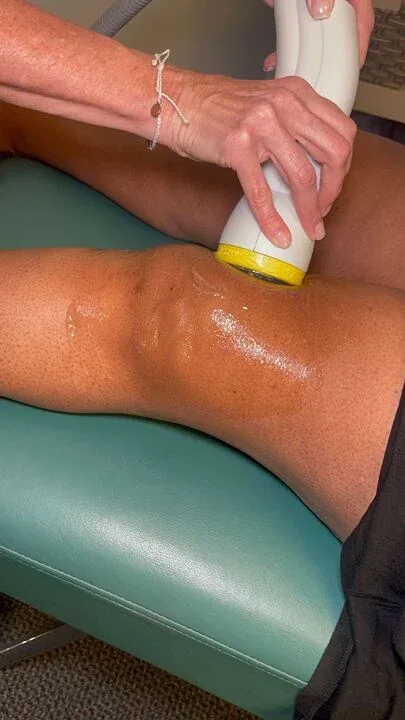
Ultrasound gel goes on, and the applicator is moved slowly around the knee: above and below the kneecap, along the inside and outside joint lines, and behind the knee if the hamstring attachments are involved. You'll feel a firm, rhythmic tapping that's stronger over the irritated spots. The intensity is adjustable and set to what you can comfortably tolerate. There's no numbing, no downtime, and you walk out on it.
How many sessions you'd need depends on the knee and how it responds. Dr. Raby sets a plan after the first treatment, and she'll be clear about what a reasonable checkpoint looks like so you're not paying for open-ended visits.
Knees don't work alone
A knee that hurts changes the way you walk, and a changed walk loads the hip and low back. Sometimes the reverse is true — a stiff hip or a restricted low back puts the knee in a bad position on every step. That's the reason a knee exam at Dynamic Chiropractic looks at the whole chain, and why some knee patients also benefit from chiropractic care for the joints above. Whether that applies to you is decided at the exam, not assumed.
Getting started
The $49 new patient visit includes your consultation, the knee exam, any diagnostics Dr. Raby needs, and your first SoftWave treatment. Bring your X-ray or MRI report if you have one — it saves a step, and it lets Dr. Raby tell you where your knee actually stands. SoftWave is self-pay and prices are subject to change; you'll have the numbers in writing before anything beyond the first visit. Book online, or read about how we approach shoulder pain if that's the joint you're actually here for.
Frequently Asked Questions
Is SoftWave a replacement for a knee replacement?
No. Knee replacement is for a joint that no longer responds to conservative care, and SoftWave doesn't change the cartilage or the bone. SoftWave is directed at the soft tissue around the knee and is used as part of a conservative plan. If Dr. Raby's exam suggests you're past that point, she'll refer you to an orthopedic surgeon rather than treat you.
I've already had cortisone or gel injections. Can I still do SoftWave?
Usually, yes. Injections and SoftWave address different things — injections act inside the joint, SoftWave is applied to the tissue around it. Tell Dr. Raby what you've had and when, and bring the records; timing since a recent injection is one of the things she'll factor into your plan.
Is there an age limit for SoftWave on a knee?
There's no upper age limit in itself, and many of our knee patients are in their 60s, 70s and beyond. What matters is the exam: what's going on in the knee, your overall health, and any medications or conditions that need to be considered. Dr. Raby screens for all of that at the first visit before treating.